
Media Secrets International Symposium 2027
Photo banner: Adhyani Wirajuda
Organisers: Annette Hill (MKV, Jönköping University) and Hario Priambodho (Lund University)
Dates: 4-5 May 2027
Venue: HLK at Jönköping University
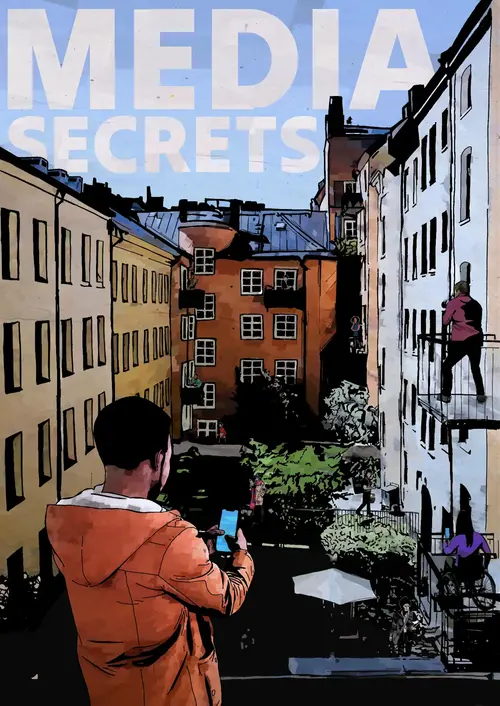
Poster illustration credit: J C Lee
Please submit an abstract of 300 words in English by December 7th 2026 to Hario Priambodho (hario.priambodho@iko.lu.se).
There is a registration fee of 2950 SEK. The fee covers lunches, beverages and snacks and an evening meal over two days.
Media Secrets International Symposium 2027
Secrets and lies. The meanings of secrets in media, culture and society are multifold. There are mysteries, the things we keep hidden from knowledge or view, such as crime podcasts or the classic whodunnit genre of television and film. It’s an age of conspiratorial thinking and opaque and clandestine activities in media and democracy are of undeniable concern, especially in light of the pressure points on media and democracy. Trade secrets protect media and communication companies, from the blackboxing of algorithmic machinery, to the strict prohibition of disclosure about labour conditions. Stealthy media can include spycraft, top secret documents and technologies, or covert practices for business, political and elite actors and organisations.
Secrets also offer spaces for manoeuvre. The move to protect anonymity of journalistic sources is crucial in fights for freedom of expression. In the opposite direction, to uncover secrets and promulgate a right to know is a critical move in strengthening media transparency and trust. Freedom of information requests are an essential means for the public to hold power to account. And yet, demands for transparency can themselves be political, selective and productive of new forms of power or opacity.
Secrets are linked with obtaining knowledge, such as discernment of machine generated content, developing tactics against media secrecy and adapting practices in the face of oppression. There are secret rituals and community routines and practices that are part of fan cultures, subcultures, or esoteric societies. And secrets are a part of everyday life, linked with performance of identities and intrigue within social relations.
This international symposium unlocks the meanings of media secrets and asks what’s mysterious, covert or hidden in media? The combination of panels, keynotes, and roundtable discussions will address critical perspectives, theoretical development, and methodological reflections on how we can better understand what are often taken for granted both with the media and through the media. Key questions include: What is the role of media and culture in keeping and revealing secrets in society? How may we deepen understanding of social phenomenon by digging beneath the surface of media and culture?
We invite researchers to explore and uncover media secrets through the following possible pathways:
- Genre, representations, or hidden meanings in pop culture, film, and television
- Media gatekeeping practices that sequester the availability of information or content
- Secret acts of resistance or activism in or through the media
- Keeping certain representations hidden or hiding the will of the people
- The obfuscation of scientific facts and truths
- Secret engagements and experiences of media and cultural events
- Defining and problematizing privacy and what should be kept secret
- Blackboxed algorithmic systems and platform infrastructures
- Media practices, representations, or societal significance of secret societies, organizations, or groups
- Selective narratives in journalistic practices
- Discreet business or organizational media and communication practices
International invited speakers include Julia Brockley (Intellect Press), Göran Bolin (Södertörn University, Sweden), Simon Dawes (Université de Versailles Saint-Quentin-en-Yvelines, France), Natalie Foster (Routledge), Christine Geraghty (Glasgow University), Joke Hermes (InHolland University, the Netherlands), Annette Hill (Jönköping University, Sweden), Dylan Mulvin (LSE, UK), Hario Priambodho (Lund University, Sweden), and Robert Willim (Lund University, Sweden).
Preliminary Programme
Preliminary Programme – 4-5 May 2027, Jönköping University
Day One
11:00 Registration
12:00 Lunch
13.15 Keynote Panel 1
Dylan Mulvin - Rage as a trace medium – Stanley Milgram and the secret CBS experiment
Simon Dawes - Who wants to know? The media hounding of Jason Arday
Christine Geraghty - Finding out secrets: a structuralist approach to narrative
14:30 Coffee and tea
15:00-17:00 Parallel Panels 1
17:00-18.15 Keynote Panel 2
Annette Hill - Seeing Everything: referential integrity in investigative documentaries about cons and conspiracies.
Joke Hermes - What was their secret? Feminism, female impersonation, drag and the Dutch comedy duo Van Kooten and De Bie.
Hario Priambodho - Away From Prying Eyes: The Secret Lives of Digital Media
18:30 Symposium dinner
Day Two
09:30-11:30 Parallel Panels 2
11:30 Coffee and tea
12:00 Lunch
13:30-15:30 Parallel Panels 3
15:30 Coffee and tea
16:00 Keynote Panel 3
Göran Bolin - Can a Large Language Model keep a secret?
Robert Willim - The Ordinarily Arcane
17:00 Academic Publishing Roundtable
Panel: Julia Brockley (Intellect Press), Simon Dawes (Media Theory journal), and Natalie Foster (Routledge)
17:45 Media Secrets Reflections
18:00 Symposium Ends
Keynote Abstracts and Bio
Christine Geraghty, University of Glasgow, UK
Finding out secrets: a structuralist approach to narrative
The holding and revealing of secrets is one of the key tropes of many genres in television drama, from soap opera to police series to reality tv. In this paper, I shall explore the detective story and draw on the work of the Bulgarian philosopher and narratologist to analyse the way stories are told in that genre. Todorov developed his research in Paris where he moved in the late 1960s and, in translation, he contributed to the arrival of critical theory in the English-speaking academy which transformed research in the arts and humanities in the 1970/80s. Although structuralist accounts were deemed to have been overtaken by post-structuralist approaches pretty quickly, I hope to show that Todorov’s ‘The Typology of Detective Fiction’ (published in English in 1977) can still offer useful groundwork for narrative (and textual) analysis of stories about secrets.
Christine Geraghty held posts at Goldsmiths College, University of London, and University of Glasgow where she taught and researched British cinema and television. She has a particular interest in fiction and form and initially specialised in soap opera, publishing Women and Soap Opera (Polity) in 1991. Her long-standing interest in narrative forms has continued in her work on British cinema, television drama and adaptation. She is an Emeritus Professor at the University of Glasgow, sits on the boards of Adaptation and Screen and is Book Reviews editor for Critical Studies in Television.
Göran Bolin, Södertörn University, Sweden
Can a Large Language Model keep a secret?
Chatbots and conversational agents that can have communicative exchanges have over the past decade become increasingly more common in everyday life. More and more of human conversation is today not between humans, but between a human subject and a machine. Most often these conversations are instrumental: we book tickets, ask for information, or for directions. Some, however, are therapeutic and social. But what are the limits of such human-machine conversations that make the conversations differ from what we most often think of when we inter into conversations? Taina Bucher, has, for example, pointed out that conversational agents lack the ability to stay silent, to not respond to human prompts. In line with this, we could also ask whether conversational agents have the ability to have secrets, and to hide information or sentiments from the human part in the conversation. This paper will explore the communicational limits of chatbots and communicative AI with respect to what the machines cannot do. It will especially focus on their ability to be deceptive when it comes to secrets.
Göran Bolin is Professor of Media and Communication Studies at Södertörn University, Sweden. His research spans social media surveillance, communication between humans and machines, and strategic communication in times of war. He is the co-author of Managing Meaning in Ukraine: Information, Communication and Narration since the Euromaidan Revolution (MIT Press 2023) and the forthcoming Paradoxes of Surveillance Society: A cross-cultural and generational perspective on state and corporate surveillance (Routledge 2027).
Robert Willim, Lund University, Sweden
The Ordinarily Arcane
This performance is an audiovisual evocation to imagine everyday life differently in a world of convoluted technologies. It meditates on the transparent and the opaque, and the constant interplay between order and mess. How is the ordinarily arcane related to questions about the site- and time specificities of attention, awareness, and ignorance? The audiovisual performance is based on live electronics, poetic storytelling and voice manipulations, the engagement with objects, site-specific recordings, and the sound of electromagnetic fields. It is combined with multi-layered video, and it is all part of my probing of Mundania.
Robert Willim is associate professor of Ethnology and senior lecturer in Digital Cultures at Lund University, Sweden. He also works as an artist. This positions his practice in the intersection between art and research, and in his work, he often experiments with hybrid forms of expression involving everything from electronic music performances and video essays to mixed media works. Lately, he has used the concept Mundania to examine the ways emerging technologies are entwined with people’s everyday life and how technological imaginaries unfold.
Joke Hermes, Inholland University and University of Amsterdam, Netherlands
What was their secret? Feminism, female impersonation, drag and the Dutch comedy duo Van Kooten and De Bie.
Van Kooten and De Bie are two grandees of Dutch television history whose career as a comedy duo spans over four decades starting in the early 1960s. They typecasted men and women, using satire to critically engage with a large range of phenomena including unopenable packaging materials, herbal medicine, white saviourism, right-wing populism and more. This paper focuses on the exceptional way they impersonated women. Often, men impersonating women make fun of femininity and use their voluntary degradation to the lesser gender as an opening for varying degrees of sexism and misogyny. Not so Van Kooten and De Bie, who enjoyed a large fan audience, including self-identified feminists. What was the secret of their success? Was it that they were ‘auteurs’ in a way, who typecasted their autobiographical selves as much as others in their performance, for instance when they were presenting their show? What made their impersonations so authentic and funny at the same time? Was it their unrelentless empathetic eye for human peculiarity? Van Kooten and De Bie’s portrayal of women characters show how men wearing women’s clothes do not need to undercut women or celebrate femininity through drag. They can also offer genuine self-expression that calls on the actor or comedian’s ability to make contact with other genders than their usual one. The paper is based on a relay series of interviews with fans who reacted to an online ad asking them for help in solving what made Van Kooten and De Bie so successful. Moving images will be supplied as illustration.
Simon Dawes, UVSQ-Paris Saclay, France
Who wants to know? The media hounding of Jason Arday
In 2026, Jason Arday, a British sociologist specialising in race, inequality and education in the UK, came under intense media scrutiny over allegations of plagiarism and discrepancies in accounts of both his academic career and personal life. He resigned from his prestigious professorial position on 5th August, citing the toll of the sustained public scrutiny and the need to prioritise his well-being. He was found dead 9 days later, just 13 days before the publication of his memoir.
Although he was neither the first person to be hounded by the British press nor the first to die in the midst of intense media scrutiny, much of the media frenzy in this case justified itself not only with reference to press freedom, the public interest and the public’s right to know about Arday’s private life, but also about the wider significance of Arday as a symbol of all Black academics, the decline of the UK’s HE sector, and the madness of DEI (or EDI) policies and “woke” multiculturalism in general. However, the publications most responsible for the intensive harassment campaign against Arday were curiously less keen to know about much more serious allegations of plagiarism against his white colleagues, or about the white supremacist sources of the largely unfounded allegations against him.
This paper will present the Arday affair within the context of debates on free speech and academic freedom, the mainstreaming of far-right discourse and the invisibilisation of white supremacist networks, and the abuse of the media’s unaccountable power to harm individuals, communities and the public sphere. More specifically it will focus on the difference between what is told and what is kept hidden, and what certain interests want us to know and what they do not, asking ultimately who really wants to know and whose interests are really served by such campaigns.
Simon Dawes is Senior Lecturer at UVSQ-Paris Saclay, France. He is the author of British Broadcasting and the Public-Private Dichotomy: Neoliberalism, Citizenship and the Public Sphere (Palgrave Macmillan, 2017) and Critiquing British Culture: Contextualising the Culture Wars (Intellect, forthcoming), as well as editor-in-chief of the journals, Media Theory and French Cultural Studies.
Annette Hill, Jönköping University, Sweden
Seeing Everything: referential integrity in investigative documentaries about cons and conspiracies.
The making of the documentary You Can See Everything (2026 A24), directed by Nathan Fielder and Lance Oppenheim was a top secret investigation that over several years looked into the secrets and lies surrounding the grand scale fraud of Elizabeth Holmes. The story of Holmes has been transformed into a podcast series, documentary, best selling book and drama series. Now Fielder brings his performative documentary mode to the topic. Even the documentary’s premiere at the Telluride Film Festival was shrouded in secrecy, audiences were asked to remove all electronic devices, locked away during the theatrical experience, and to keep secret the reveals of the documentary until after general release. Fielder asked audiences at the festival screening of You Can See Everything to help him understand his experience in uncovering secrets.
This talk examines the referential integrity of long form documentary writers, producers and film makers doggedly investigating the erosion of boundaries between factuality and fabrication. The work of Nathan Fielder is one case that will be explored, alongside journalist Patrick Raddon Keefe and his book London Falling (2026) in which he investigates the suspicious death of a teenager who pretended to be the son of a Russian oligarch to gain entry to the superrich game of real estate monopoly; and the documentary podcast and film The Walkers by Chloe Hadjimatheou that uncovers the con behind the bestselling memoir and Hollywood film The Salt Path.
The referential integrity takes the shape of factual forensics, offering audiences a granular level to back stories, motivations, and consequences of creating, keeping and revealing secrets in these various cases. The talk draws on long standing discussions related to indexicality that blur distinctions between the integrity and performativity of photographs that reference the real world. These current documentary investigations into fraud and deception highlight an erosion of facts that are related to broader instability in trust and truth in the media, what we can call post referentiality. At the same time, the work of producers and audiences is paramount in shoring up facts, finding markers of referential integrity in a media landscape.
Annette Hill is Professor in Media and Communications at the School for Education and Communication, Jönköping University, Sweden. Her research focuses on media audiences, media engagement and experiences, everyday life and cultures of viewing. Her most recent books are Media Imaginaries, with Joke Hermes and Simon Dawes (Intellect 2026) and Media Frictions, with Christine Geraghty, Joke Hermes and Simon Dawes (Routledge 2026).
Dylan Mulvin, LSE, UK
Rage as a trace medium – Stanley Milgram and the secret CBS experiment
Known now for the ethically dubious and often cruel experiments they conducted, social psychologists of the 1960s and 70s were also possessed by an interest in the study of film and television. In 1969, Stanley Milgram began a secret collaboration with CBS’s Office of Social Research. The result was an episode of the hit drama Medical Center with three distinct endings. Airing the different endings for different audiences across the United States, Milgram attempted to trace memetic reenactments of violence and abuse in the public. In essence, the CBS experiment enrolled millions of American viewers in a hidden, social experiment on the effects of mediated anger and transformed the living room into a gargantuan laboratory.
Virtually untouched in the historiography of psychology or television, the Medical Center experiment represents one of, if not the largest natural psychological experiment of the twentieth century. What to make of this? How do we place such brazen exploitations of media infrastructure and ordinary vulnerability within the longer trajectory of experimental exploitation (including the use of social media platforms)? And how do we think about the living room itself as an experimental site, a location that promises to secrete deep social meaning?
Drawn from archival research in Milgram’s papers at Yale University, I analyse how social psychologists of this period constructed their experiments around anger as a kind of trace medium, animating the formation of human subjectivity within complex media ecosystems. In experiments like Milgram’s anger was construed as a substance through which the social might expose itself.
Thus I take up the longer historical investigation of psychology, film, and television, joining existing work that views the psychologist as a hybrid media producer/subject. By undertaking this project within a broader history of rage and media I recover the ways anger, frustration, and psychological research were intricately connected in the media environments of the 1960s.
Dylan Mulvin is Associate Professor of Media and Communications at the London School of Economics. A media historian, his work investigates the intersection of technology and the body. He is the author of Proxies: The Cultural Work of Standing In (MIT 2021).
Hario Priambodho, Lund University, Sweden
Away From Prying Eyes: The Secret Lives of Digital Media
If a tree falls in the middle of the forest and no one is around to hear it, does it make a sound? This classic philosophical prompt is the starting point to ruminating the extent and magnitude of automated web crawlers. Since its conception, the internet has grown into an unimaginably vast ecosystem where automated actors are operating. Among those, web crawlers, scrapers, trackers, and bots owned and operated by numerous tech companies continuously collect and classify data every second, away from the view of everyday internet users. These complex applications are built for different purposes, from indexing the internet, obtaining relevant data about the global structure of a network, to most pertinently, training AI models. However, web crawlers have traditionally raised several issues primarily revolving around security and privacy.
Taking inspiration from the stealth politics and secrecy strategies of the elites and powerful, this paper attempts to contextually elucidate the operational magnitude of web crawlers as too big to quantify and argues they are also sequestered from the public, rendering them as a social inequality issue, an issue in privacy, and a moral issue. Because of the proliferation and development of AI in recent times, debates on the essence and values of privacy have been intensified. An almost equal reaction of resistance has naturally grown out of the increased discourse and awareness of data collection practices. This is exemplified in recent literature that conceptualize notions such as data colonialism, data capitalism, and data politics. Many apps, plugins, and websites are designed specifically to resist automated incursions such as the bot-stopping plugin Anubis, or the zoology-inspired CrawlerZoo. Behind the curtain of interfaces and design, a struggle is being fought between crawlers and countermeasures that inhibit the abilities of automated data collectors.
This line of thought manifests in an inquiry of how we can conduct empirical research that caters towards the socio-cultural dimensions of AI and web crawler activities in relation to the greater issues of consent, data ownership, transparency, and ethical use of public information. So much is going on in the background of digital media we use daily where invisible infrastructures shape our contemporary digital lives. Therefore, it begs the question: should we care about it and how?
Hario Priambodho is a senior lecturer at the Department of Communication, Lund University, Sweden. He is a media audiences and media industries researcher, with a recent focus on the intersections of media atmospheres, media engagement and experiences, and film. He is also interested in the discussions around the felt experiences of digital media and trash media.


